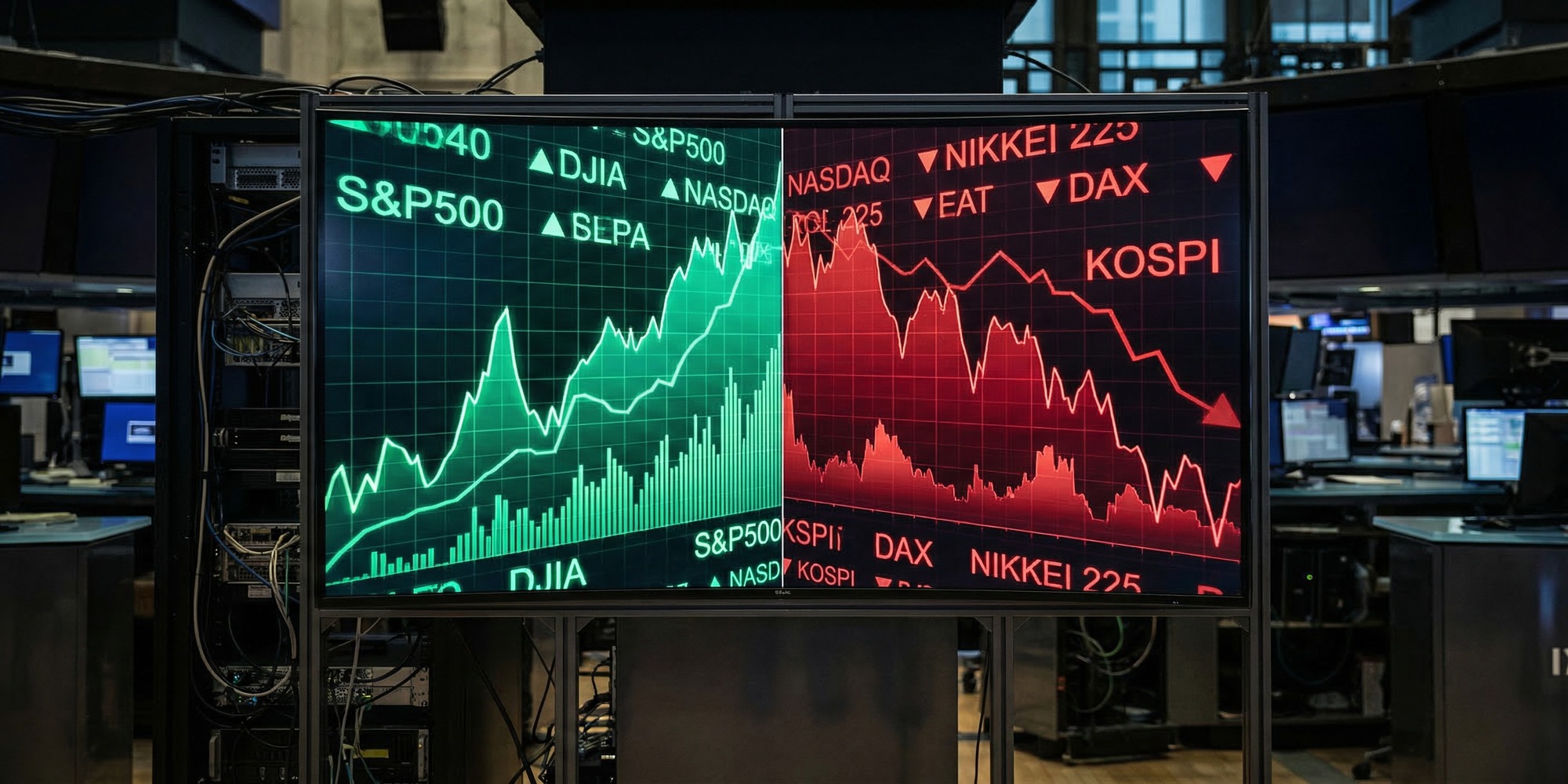
Global fund managers are hoarding cash at the fastest rate since the COVID crash of March 2020. The Bank of America Global Fund Manager Survey released March 18 shows average cash allocations jumped to 4.3% in March — up from 3.4% in February — the largest single-month increase in six years. The move reflects a decisive shift in institutional sentiment: from the AI-fuelled optimism that dominated late 2025 to a defensive posture driven by geopolitical risk, stagflation anxiety, and a rapid repricing of the global rate outlook. Against this backdrop, the Hang Seng Index closed Friday at 25,277.32, down 0.9% on the session, while the Shanghai Composite slipped below 4,000 points for the first time in 2026. Yet within those grim headline numbers lies a more nuanced story: China's mainland equity market is outperforming every major global benchmark since the Iran conflict began.
Sentiment Turning Point
The scale of the sentiment reversal captured by the BofA survey is difficult to overstate. Investor sentiment fell to a six-month low in March, and nearly every forward-looking indicator has deteriorated sharply. The proportion of managers expecting higher global consumer prices over the next 12 months surged to 45% — up from just 9% in February, a 36-percentage-point swing in a single month. That is the kind of rapid shift that normally accompanies a genuine macroeconomic inflection.
Rate cut expectations have collapsed in parallel. Only 17% of managers now expect lower short-term rates ahead — down from 46% in February, and the lowest reading since February 2023. The investor base that was positioned for an easing cycle just weeks ago has largely abandoned that thesis. Growth expectations have deteriorated even more dramatically: the share of managers forecasting stronger global growth plunged from 39% to 7% in one month, a 32-point fall that few surveys in the series' history can match.
The most consequential indicator may be the stagflation reading. 51% of survey respondents now expect below-trend growth combined with above-trend inflation over the coming year — up from 42% in February. The last time a majority of professional investors held a stagflation view, energy markets were still absorbing the aftershocks of Russia's 2022 Ukraine invasion.
"The frothy bull positioning of late 2025 has been replaced by bunker mentality. This is not a tactical de-risking — it is a structural portfolio reset."
— BofA strategist Michael Hartnett, March 18, 2026
Asia's Split: Hong Kong Bears the Weight, Mainland Shows Relative Resilience
Hong Kong's equity market continued to reflect the full weight of the oil shock and global risk-off move. The Hang Seng posted its third consecutive weekly loss, falling 0.7% over the five-day period ending March 20. Corporate earnings compounded the macro pressure: Alibaba Group tumbled 6.3% to HK$123.70 after reporting a 67% slump in quarterly earnings — a result attributed to weaker domestic consumer spending and rising cloud computing competition. Xiaomi sank 8.6% to HK$33.20 following its new EV product launch, which underwhelmed investors expecting more aggressive pricing. The CSI 300 retreated 0.4% on Friday, and the Shanghai Composite closed below 4,000 for the first time since December 2025.
Yet the comparison against global peers tells a different story. Since US-Israeli forces struck Iran on February 28 — the event that triggered the current Brent crude surge above $100 per barrel — the CSI 300 has declined only 3.1%. The S&P 500, Nikkei 225, and Euro Stoxx 50 have each fallen more than 4% over the same period. As US equity markets entered their fourth consecutive week of losses, China's relative outperformance has drawn attention from institutional analysts tracking the geopolitical energy shock. During the four prior major oil disruptions between 2011 and 2025, the CSI 300 fell an average of 8.4% — making its current drawdown of 3.1% a significant positive outlier, according to Citigroup analysis cited by SCMP Markets on March 20.
China's Green Dividend
The explanation for China's relative resilience lies partly in a structural energy transition that has quietly reduced the country's vulnerability to oil price shocks. China's consumption of non-fossil fuels rose 2 percentage points last year, surpassing oil to become the second-largest energy source in the Chinese economy. Non-fossil fuels now account for an estimated 22% of China's total energy mix, with projections from the National Bureau of Statistics pointing toward 27% within five years. That structural shift means Brent crude at $100-plus transmits less economic pain per dollar of oil-price increase than it did five or ten years ago.
China's dominance in clean energy manufacturing reinforces the insulation. The country supplies 60% of global lithium battery production, 44% of solar panels, and 39% of wind power equipment — industries whose inputs are largely denominated in yuan and whose costs are structurally divorced from crude oil markets. Citigroup analyst Xiangrong Yu noted that China faces "limited disruptions to its domestic economy given diversified import sources, strategic oil reserves, and expanding use of renewables" — a judgment reflected in the relative equity performance data.
The geopolitical dimension adds another layer. The fracturing of the Hormuz coalition among Western allies has created asymmetric pressure on import-dependent economies whose energy supply chains run through the Persian Gulf. China's combination of strategic reserves — estimated at 90 days of consumption — diversified import origins, and the ongoing domestic energy transition has positioned it differently from Japan, South Korea, and Germany, all of which have absorbed sharper equity declines since the conflict began.
What to Watch
Several catalysts will shape the trajectory of both the cash-hoarding trend and China's relative outperformance in the week ahead. The Xi-Trump summit, which markets have been anticipating as a potential signal for trade de-escalation, has yet to receive a confirmed date — any announcement would likely generate a significant risk-on response in Asia Pacific equities. Israel's stated pause on targeting energy infrastructure — announced late Friday after Brent pulled back from its intraweek spike to $113-$115 on strikes near Iran's South Pars gas field — will need to hold through the weekend to ease supply anxiety.
On the macro calendar, talk of an OPEC+ emergency session has intensified, with Saudi Arabia and the UAE under pressure to respond to supply disruption narratives. The EU flash inflation estimate for March will be closely watched given the sharp upward revision in BofA's inflation expectations reading. In the US, the February PCE deflator — the Federal Reserve's preferred inflation gauge — due late next week carries unusual weight: any upside surprise would make the already-slim case for 2026 rate cuts even harder to sustain. The HKMA, which kept its base rate at 4% following the Fed's hold at 3.5%–3.75% on March 19, has separately warned the public to "carefully manage interest rate risks" — a signal that the Hong Kong dollar's peg to a potentially-higher-for-longer Fed rate path is a real household exposure.