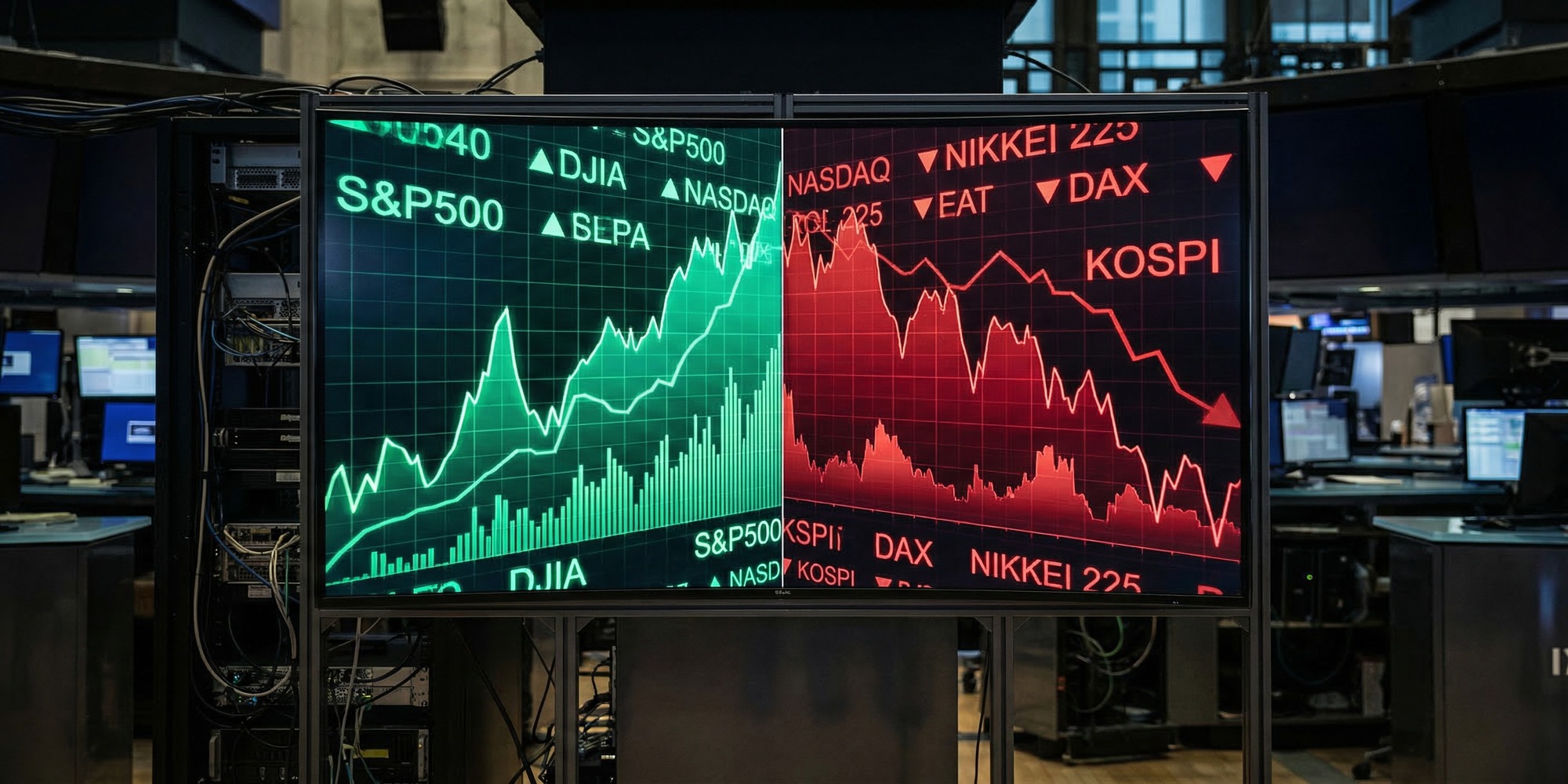
The most consequential story in global markets right now is not where prices are — it is where they are diverging. As of mid-March 2026, the S&P 500 has retreated approximately 5% from its all-time highs and has shown signs of stabilization near 6,632. Every other major benchmark has done far worse. The MSCI All Country World Index has dropped nearly 10% over six weeks, the Nikkei 225 lost 5.2% in the week ending March 14 alone, and Europe's DAX and CAC 40 have both crossed into correction territory — defined as a decline of 10% or more from recent peaks. The geographic split is now wide enough to have its own name: the Great Decoupling.
How the Decoupling Works
Three structural forces explain why US equities are holding relative ground. The first is energy. The United States became a net oil and gas exporter in 2023 and maintains significant domestic production capacity. When Brent crude spiked above $119 per barrel intraday — and has since stabilized in the $95–$100 range on the ICE — US energy companies absorbed a windfall rather than a cost. ExxonMobil and Chevron have reached record valuations. GE Vernova, the grid infrastructure spinoff, is booked out through 2028. For Germany, Japan, South Korea, and India, the same price increase functions as a direct tax on industrial input costs with no domestic production offset.
The second force is the US dollar. The DXY index has firmed materially since the Iran conflict began on February 28, driven in part by safe-haven demand and in part by the expected hawkish succession at the Federal Reserve. Kevin Warsh, nominated to succeed Jerome Powell, has signaled a strong preference for monetary discipline — a "Warsh premium" that is drawing capital into US assets and adding a further cost multiplier for non-US economies importing dollar-denominated commodities. Washington's pressure on Beijing to lean on Tehran — and the risks to global markets if a stalled Trump-Xi summit prolongs Hormuz uncertainty — adds a geopolitical dimension to the monetary divergence.
The third force is the perceived utility-infrastructure status of large-cap US technology. Microsoft, Nvidia, and Palantir have traded as quasi-defensive assets rather than speculative growth plays. CrowdStrike has seen elevated demand as cyber-conflict concerns grow alongside the Middle East confrontation. The "Technology Sovereignty" thesis — that US AI infrastructure is not discretionary but strategic — has insulated this cohort from the broader risk-off move.
The Global Losers: Europe and Asia
The damage to energy-importing economies is structural, not cyclical. In Japan, manufacturing margins are compressed by import cost inflation while the yen has weakened, amplifying the cost of dollar-priced commodities. The Bank of Japan is expected to hold at 0.75% amid global uncertainty, providing no relief. South Korea's KOSPI fell 6% in the week of March 9–14 as semiconductor demand softened and energy costs pressured export-oriented conglomerates. TSMC faces a secondary supply chain headwind: a global helium shortage — partly traceable to Middle East logistical disruptions — has added production risk to chip manufacturing at the margin.
Europe has been hit harder than Asia. The Hormuz crisis entered its third week after GCC nations publicly pushed for Iran's permanent disarmament, complicating the diplomatic resolution that energy-importing economies need urgently. European TTF natural gas prices have risen 61% since Iran's attacks on February 28 — an unprecedented shock for an industrial base still recovering from 2022–2023 energy disruptions. BASF's CEO has warned of capacity loss at current gas prices; automotive supply chains face compounding headwinds from Hormuz logistics and weakening consumer sentiment.
Credit markets are reflecting contained but elevated stress. The US high-yield option-adjusted spread reached 298 basis points in the week of March 15, up 17 basis points week-over-week. Investment-grade spreads moved 9 basis points to 88 basis points. The VIX closed at 27.19 on March 15 — the 91st percentile over five years — signaling equity-specific stress rather than credit contagion. This is orderly widening, not dislocation, but the direction is unambiguous.
FOMC as Today's Catalyst
The single largest variable for global equity direction this week is the FOMC decision at 2:00 PM ET today, March 18, followed by Chair Powell's press conference at 2:30 PM. The rate decision itself is a near-certainty: CME FedWatch showed a 92%+ probability of a hold at 3.50–3.75% heading into the meeting, and the underlying data supports it. Core PCE inflation stood at 3.1% year-on-year in January 2026 — well above the Fed's 2% target — while Q4 2025 GDP came in at just 0.7% annualized and February payrolls showed a loss of 92,000 jobs. The combination of weakening growth and sticky inflation is a textbook stagflation warning, leaving no room for accommodation.
The real market mover is the Summary of Economic Projections — the dot plot. December 2025's median dot showed one cut in 2026. Markets are pricing roughly 20 basis points of easing for all of this year, down from approximately 75 basis points at the start of January. Goldman Sachs has pushed its cut forecast to September 2026; Barclays projects a single cut for the full year; EY-Parthenon's Gregory Daco has raised the prospect of no cuts, or even a hike. The 30-year US Treasury yield reached 4.91% in the week of March 15 — the 95th percentile over five years — signaling that bond markets are pricing inflation risk over growth risk, an unusual configuration that the dot plot update will need to address directly.
A hawkish outcome — zero cuts signaled for 2026 — would extend the dollar's strength, apply further pressure on international markets, and continue the decoupling dynamic. A dovish surprise — two or more cuts signaled — would likely trigger a relief rally across international benchmarks, ease emerging-market borrowing costs, and narrow the US/rest-of-world gap. US equities had mounted a brief two-day recovery ahead of the decision — a detailed sector breakdown is available at US Market Updates — but traders remained cautious, holding positions ahead of the dot plot outcome.
What to Watch
The calendar after today's FOMC is dense with second-order catalysts. The ECB decides Thursday, March 19, with a hold at 2.00% expected alongside revised staff projections that will need to incorporate the gas price shock; the Bank of England also decides Thursday. Bank of Japan and China's loan prime rate decisions follow later in the week. The first post-oil-shock US labor market reading — March nonfarm payrolls — arrives April 3. March CPI on April 10 will provide the clearest picture of whether Brent's $100+ episode passed through to consumer prices as quickly as pump prices (+22% since February 28) suggest.
The Great Decoupling is a real phenomenon with identifiable structural drivers. But it is not permanent. The US remains exposed to second-round inflation effects, weakening export demand from its largest trading partners, and — if the Iran conflict extends past Q2 — a domestic energy price shock of its own. The thesis has a shelf life measured in months, not years. What ends it first — a Hormuz resolution, a Fed pivot signal, or a deterioration in US labor data — is the question investors will be watching long after today's press conference ends.