
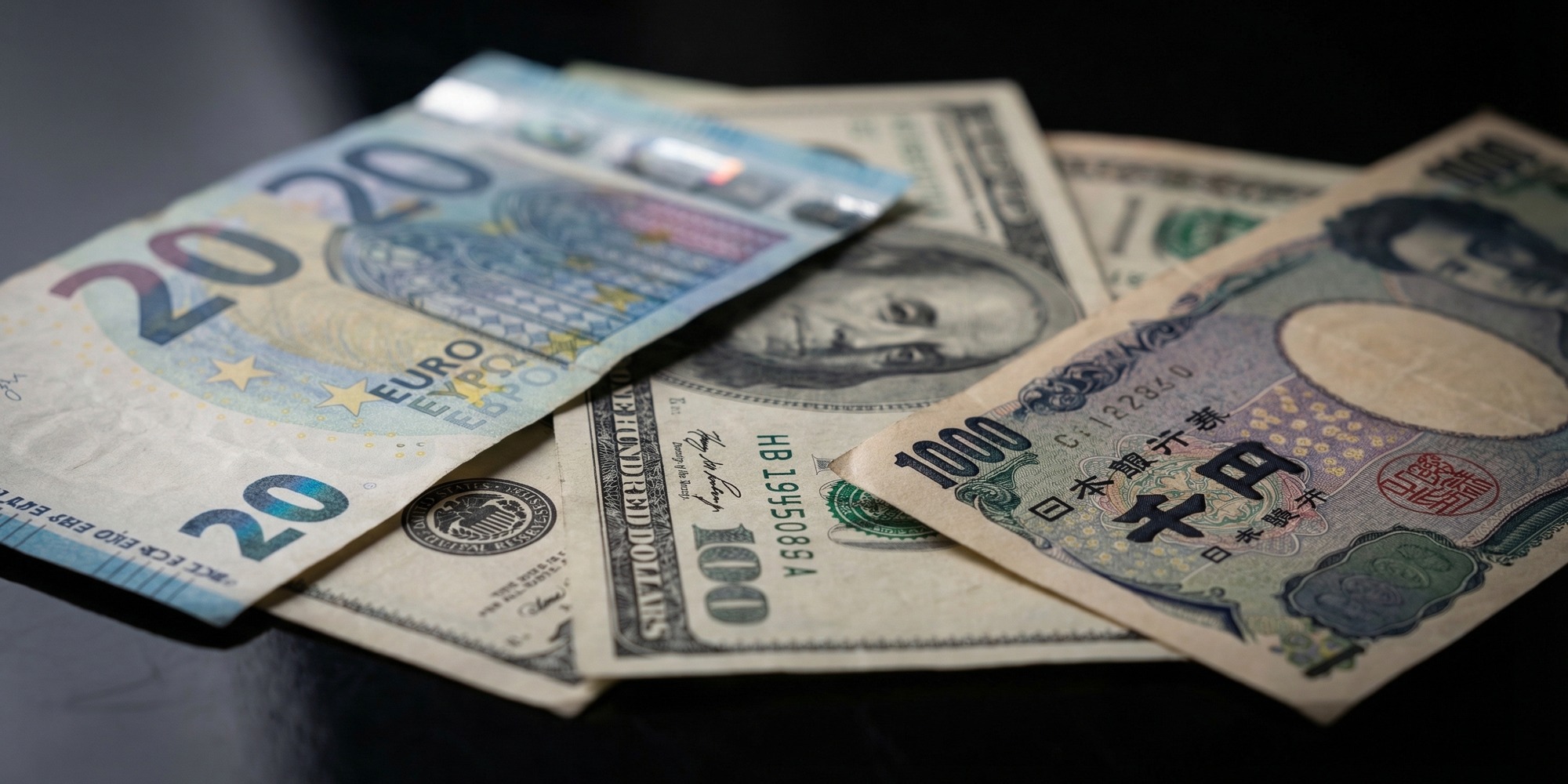
The euro slipped for a second consecutive session on Wednesday, falling 0.38% against the dollar to 1.1567 as Brent crude climbed 4.72% to $91.94 per barrel and Iran continued to threaten vessel passage through the Strait of Hormuz. The move illustrated a deepening divergence in global currency markets twelve days into the US-Israeli conflict with Iran: energy-importing currencies face renewed pressure as oil reasserts itself, while the Japanese yen extended session gains by 0.50%, pulling USD/JPY back toward 158.73 as investors sought shelter from accelerating geopolitical risk.
Euro Under Pressure as Energy Import Risk Deepens
The eurozone's structural exposure to energy imports has made the single currency a direct casualty of the Hormuz disruption. The European Union imported approximately 97% of its crude oil requirements in 2024, according to the European Commission's energy statistics, leaving the bloc's trade balance acutely sensitive to sustained oil price moves. With Brent now 53% above its January 2026 level of roughly $60 per barrel, Europe's current account arithmetic has deteriorated sharply — a dynamic that continues to weigh on the currency even as prices remain well below the $115.20 intraday peak reached on March 9.
European bond markets reinforced the pressure on Wednesday. The German 10-year Bund yield rose 6.7 basis points to 2.93%, reflecting markets pricing a more persistent inflation overhang from elevated energy costs. UK gilt yields climbed a sharper 12.9 basis points to 4.684% — the largest single-session move in several weeks — as British inflation data scheduled for release next week is widely expected to show renewed upward pressure from transport and household energy bills. Sterling itself retreated 0.18% against the dollar to 1.3393.
Iran's threat posture remained elevated Wednesday after the United States reported destroying more than a dozen Iranian vessels suspected of laying maritime mines across the strait. Several governments have authorised preliminary releases from strategic petroleum reserves in coordination with the International Energy Agency, but the announcements have so far failed to sustainably cap prices, with crude repeatedly recovering any relief-driven declines within hours.
Yen Firms Despite Broader Dollar Strength
The Japanese yen's 0.50% session gain against the dollar — pulling USD/JPY from approximately 159.52 toward 158.73 — stands out against a backdrop of broader dollar strength versus European currencies. The yen's behaviour reflects its dual role in this conflict: it carries the traditional safe-haven bid of an externally creditor nation with deep current account surpluses, even as Japan itself faces significant energy import costs from the oil shock.
The Nikkei 225 added 1.43% to close at 55,025.37, the strongest performance among major global indices on a day when the Euro STOXX 50 fell 0.69%, the FTSE 100 dropped 0.74%, the S&P 500 retreated 0.33% to 6,759.19, and the Dow Jones Industrial Average shed 0.93% to 47,261. Japan's outperformance likely reflects export-sector earnings benefits from the yen's still-historically-weak position against the dollar since the conflict began, as well as domestic demand resilience in the face of oil price uncertainty. The Bank of Japan's 10-year JGB yield edged up just 0.4 basis points to 2.165% — a fraction of the moves in US Treasuries and European bonds — underscoring the BOJ's continued backstop and Japan's distinct inflation profile relative to energy-importing Western economies.
US equity markets have tracked the daily cadence of ceasefire signals throughout the conflict. As US Market Updates reported Wednesday, the Dow and S&P have struggled to find directional conviction as oil reasserts itself following Monday's brief rally on Trump peace signals — a pattern directly correlated with the dollar's own choppy intraday trajectory.
Bond Yields Signal Persistent Inflation Risk
The cross-market picture on Wednesday pointed to a consistent theme: investors pricing a more prolonged inflation episode than many central bank forward guidance frameworks anticipated at the start of the year. The US 10-year Treasury yield rose 5.5 basis points to 4.191%, with the move driven by expectations that February CPI data — due Thursday — will show oil-driven upward pressure on headline inflation. Gold, serving simultaneously as an inflation hedge and geopolitical safe haven, added 1.10% to $5,172.20 per troy ounce on the COMEX, well above its pre-conflict range near $4,500 but below its record intraday high of $5,400 reached on March 1.
"The pattern in European sovereign spreads and currency pairs is consistent with markets repricing a second energy inflation shock — not a replica of 2022, but in the same structural family."
— Reuters, quoting a senior fixed-income strategist, March 11, 2026
What to Watch
Currency traders will track several catalysts in the days ahead. The ECB's March 19 monetary policy meeting — its first since the Iran conflict began — will be closely watched for any signal on how Frankfurt plans to navigate an externally imposed inflation shock. ECB projections published earlier this year assumed Brent averaging approximately $65 per barrel through 2026; the actual trajectory is now running 40% above that baseline, with direct implications for the inflation and growth outlook underlying the bank's rate guidance.
On the diplomatic front, Gulf state intermediaries continue to press for a framework that could stabilise Hormuz flows. Foreign Diplomacy reported Tuesday that Qatar and Oman have separately engaged with Iranian interlocutors on a phased ceasefire structure — a development that, if credible, could rapidly reverse the current currency pressure on the euro and sharpen the yen's safe-haven premium. Any sustained resolution in the Strait would likely see EUR/USD recover and USD/JPY drift higher as the flight-to-safety premium unwinds.
The US dollar index will also face a critical test from Thursday's February CPI print, which carries more directional weight for Fed rate expectations than any single data point since the conflict began. A hotter-than-expected reading could extend the dollar's gains against the euro while simultaneously capping the yen's safe-haven outperformance, compressing the intraday divergence that defined Wednesday's session.