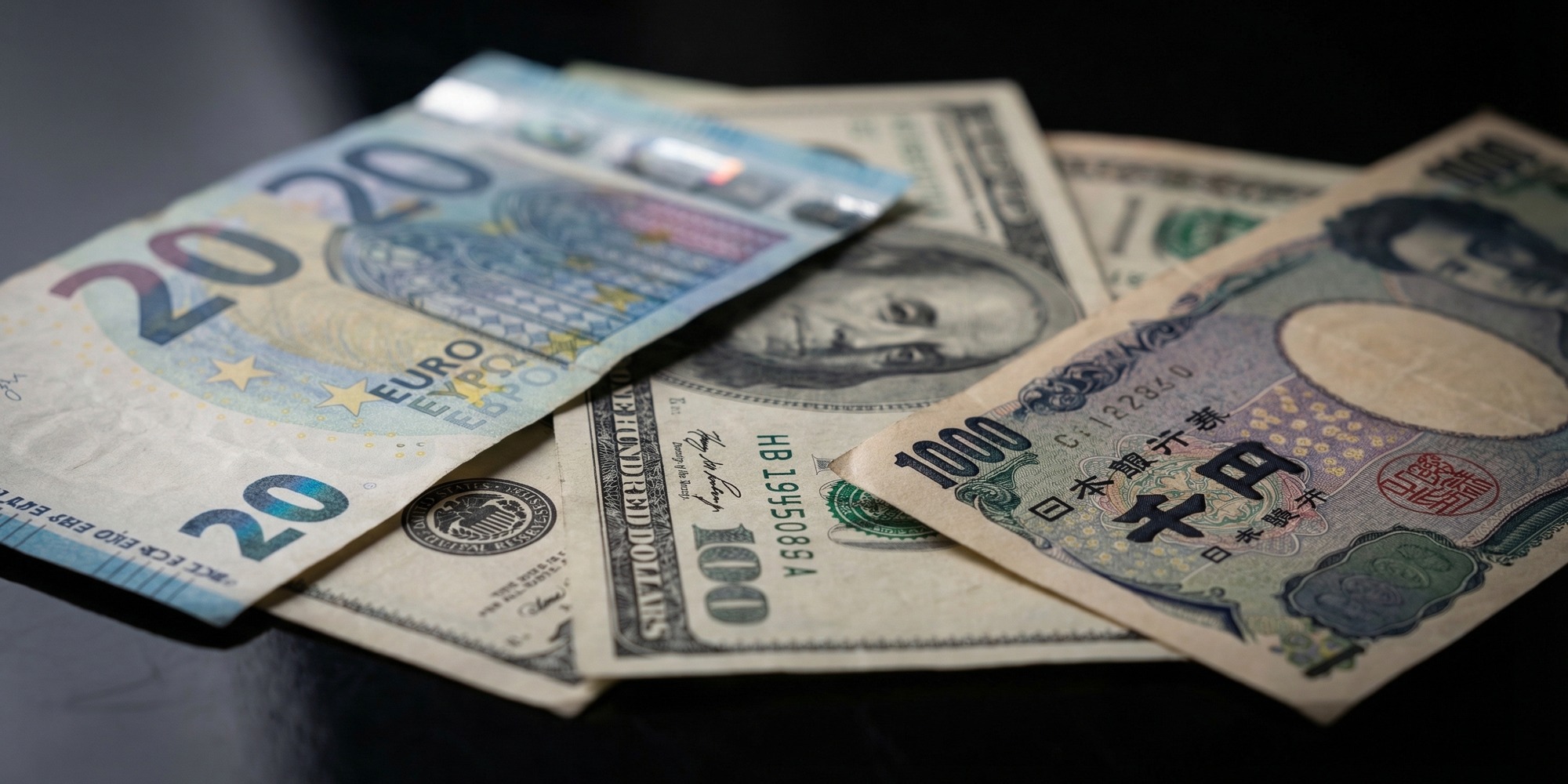
The US dollar retreated from a 10-month high this week, posting its steepest weekly decline since late January, as a wave of central bank decisions flipped the global interest rate differential against the greenback. The DXY index fell approximately 1% to settle near 99.20–99.46, down from the 100.54 peak reached on March 13 — a level not seen since May 2025. The counterintuitive move — dollar weakening even as a Middle East war persists — reflects a critical repricing: the Iran war's oil shock is now triggering inflation scares globally, and central banks outside the United States are responding faster and more aggressively than the Federal Reserve.
The Rate Differential Shift
The Fed opened the week on Wednesday by holding rates steady at 3.50–3.75%. Chair Jerome Powell acknowledged the Iran conflict's economic risks but declined to commit to a timeline for cuts, stating it was "too soon to know the scope and duration" of the war's economic fallout. The updated dot plot now projects one rate cut in 2026, reduced from two, with markets pricing approximately 25 basis points of easing — a far cry from the 100-plus basis point cut cycle that market participants had expected at the start of the year.
The contrast with other central banks was stark. The Reserve Bank of Australia had delivered a 25 basis point hike on Tuesday, lifting its cash rate to 4.10% — a 10-month high and its second consecutive monthly increase. The RBA has now reversed two of the three rate cuts it executed in 2025. In its statement, Governor Michele Bullock warned that "risks to inflation have tilted further to the upside," citing energy price pass-through from the Middle East conflict.
"Every central banker in the world is looking at the inflation effects, the likely output effects and asking themselves 'how much credibility do I have?'"
— Steve Englander, Global Head of G10 FX Research, Standard Chartered
The European Central Bank held its policy rate at 2.00% on Thursday but delivered a markedly more hawkish tone than its previous statement. Sources told Reuters that ECB policymakers are likely to formally discuss rate hikes at the April meeting. Before the Iran conflict began in late February, markets had priced approximately a 50% chance of an ECB rate cut in 2026. By Friday's close, they were pricing nearly two hikes. The Bank of England also held unanimously but signalled readiness to tighten, triggering what analysts described as one of the sharpest ever routs in short-dated gilts. Markets moved to price 80 basis points of BOE hikes by year-end.
"The Fed is signalling a longer pause if inflation stays sticky; the ECB is opening the door to insurance hikes."
— Wei Yao, Global Chief Economist, Societe Generale
Currency-by-Currency Breakdown
The euro was the week's headline performer among major currencies, rising 1.2–1.4% against the dollar to settle in the $1.1558–$1.1585 range. The move was almost entirely ECB-driven: before the Iran war, the eurozone's central bank had been charting a path of additional easing. That path is now closed. As US diplomatic efforts in the region remained unresolved, energy import costs across the eurozone continued to compound, accelerating the ECB's hawkish tilt.
Sterling gained 1.4–1.5% to $1.3408–$1.3436. The pound's advance was powered by the BOE's hawkish hold and the subsequent violent repricing of gilt markets. UK inflation remains highly sensitive to energy import costs given Britain's structural position as a net energy importer — a vulnerability the BOE flagged explicitly in its statement. The yen recovered 0.9–1.4% against the dollar to approximately 157.61–158.00, as the Bank of Japan maintained its hawkish bias and signalled a possible rate hike at the April meeting. The move caught yen short-sellers off guard, though USD/JPY remains significantly above pre-conflict levels.
The Australian dollar was the week's outright standout, advancing approximately 1.5% to near $0.71. The AUD benefits from two simultaneous tailwinds: the RBA is now the only major central bank already in active hiking mode, and Australia's commodity export profile insulates it somewhat from the oil import cost pressures battering Europe and Asia. The Swiss franc also gained, with USD/CHF falling to 0.7846, as the currency absorbed both safe-haven demand and repriced SNB expectations. Among energy exporters, the Norwegian krone and Canadian dollar outperformed their G10 peers. Emerging market currencies in oil-importing economies — the Indian rupee, Korean won, and Turkish lira — remained under pressure from twin energy import costs and residual dollar strength.
The Dollar's Structural Tension
Despite this week's pullback, the dollar's structural position remains supported. The DXY is only back to approximately 99 after surging more than 5% from its mid-February level near 96 to test 100–100.5 in early March. Many analysts characterise this week as a correction within a broader dollar-supportive environment, not a reversal of trend. US equity markets, while under pressure from war-related inflation concerns, have proven considerably more resilient than European and Asian benchmarks — a dynamic that historically supports the dollar over time.
The US economy's energy export profile is a critical variable. As a net exporter of oil and natural gas, the United States is substantially less exposed to the terms-of-trade deterioration hitting Europe, Japan, South Korea, and India. The Fed's "wait and see" stance is an affordable posture for the world's largest energy-producing economy. For the ECB, BOE, RBA, and BOJ — governing economies that pay higher import bills every time Brent crude climbs $10 — a longer Fed pause simply increases the inflation differential, forcing their hands toward tighter monetary policy and, consequently, weaker dollars.
Outlook: What to Watch
The April BOJ meeting is the most immediate catalyst for USD/JPY. Any explicit guidance on rate hike timing will test whether the yen's recovery extends or reverses. The ECB's April meeting carries equal weight for EUR/USD: formal confirmation of a hawkish tilt would validate the market's current pricing of two hikes; any retreat from that posture could drag the euro back sharply. Both scenarios hinge in part on geopolitics. The US diplomatic position toward Iran remains a key variable — any credible de-escalation signal would compress oil prices and ease the inflation pressure currently driving central banks away from easing. Re-escalation, particularly any renewed disruption to Hormuz transit, would accelerate the global inflation repricing and likely push energy-importing currencies lower against the dollar regardless of rate differentials. BOE MPC minutes for April will reveal how close the committee came to voting for an immediate hike — a detail that markets will parse closely. Finally, US CPI for March, due in April, represents a potential reversal catalyst: if US inflation surprises to the upside, the Fed's "wait and see" posture could shift toward hawkishness, recapturing some of this week's dollar losses and compressing the rate differential that has driven the greenback lower.