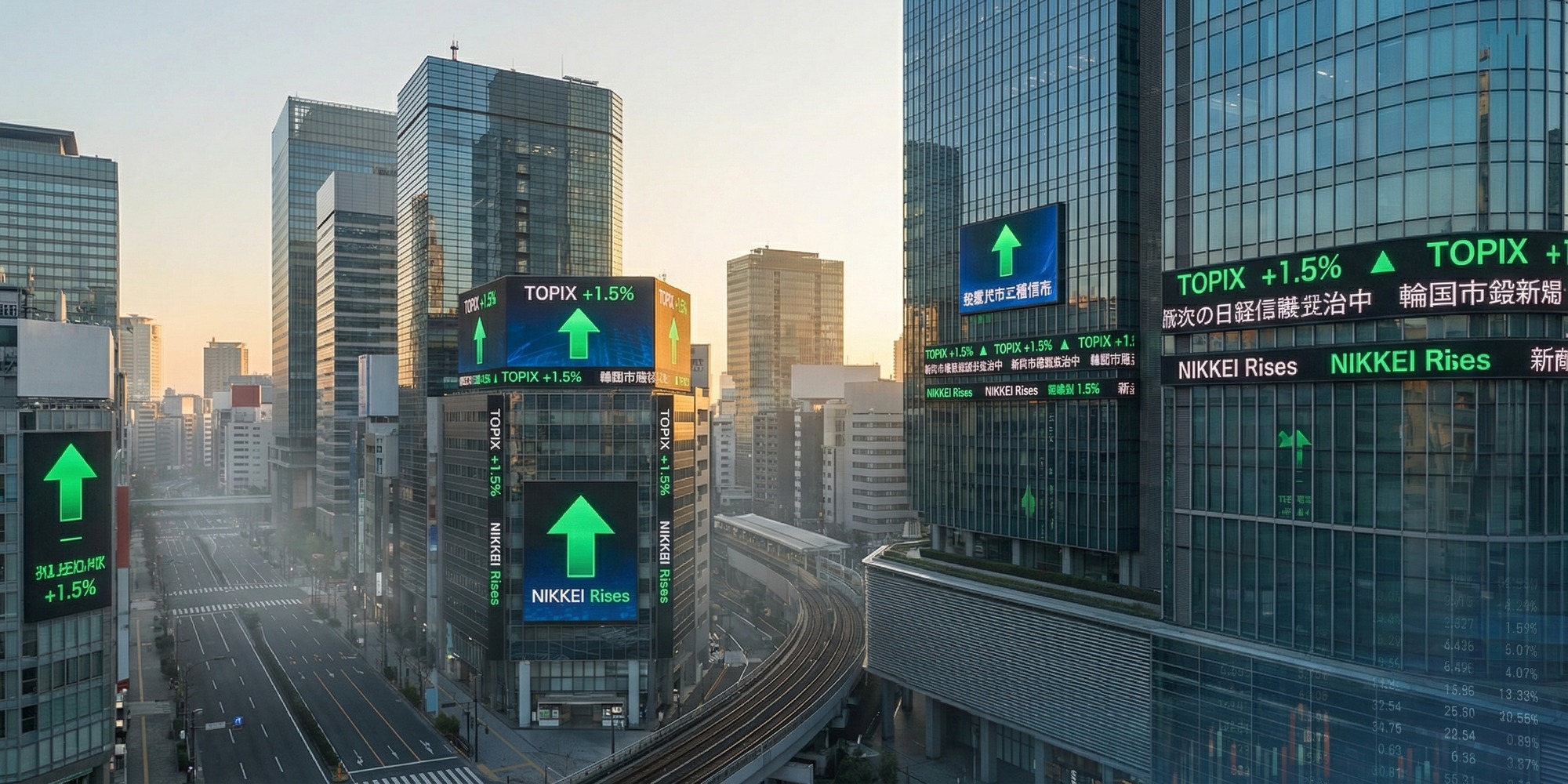
Asian equity markets reversed course on Thursday as contradictory signals from Washington and Tehran extinguished the optimism that had briefly powered a regional rally the day before. South Korea's KOSPI fell 2.7%, Hong Kong's Hang Seng Index dropped 2.0% to 24,829.54, and Japan's Nikkei 225 — which had surged 2.87% on Wednesday — reversed early gains to trade 0.27% lower at 53,603.65. The MSCI broadest index of Asia-Pacific shares outside Japan slid more than 1% on the session, putting it on track for a 9.5% decline in March — its steepest monthly loss since October 2022.
The catalyst for the reversal was a sharp contradiction between U.S. and Iranian statements overnight. President Donald Trump said Iran was "desperate to make a deal" to end nearly four weeks of fighting. Iranian Foreign Minister Abbas Araqchi, however, denied any dialogue or negotiations had taken place, acknowledging only that various messages had been exchanged through intermediaries. The gap between those positions proved too wide for markets to bridge.
It looks like the market's relief trade is starting to wobble. Traders are also remembering that one peace rumour does not undo the inflation and rates damage already in the system.
— Charu Chanana, Chief Investment Strategist, Saxo, March 26, 2026
European stock futures signalled a lower open on the continent. U.S. equity futures were also in negative territory, suggesting that Wall Street's scepticism from the prior session — when the S&P 500 fell 0.37% even as Asian markets surged — would continue to be validated.
Regional Breakdown: Korea and Hong Kong Lead the Decline
The geography of Thursday's losses reflected the uneven structure of Asia's exposure to the Iran conflict. South Korea's KOSPI, bearing heavy dependence on energy imports and export sector sensitivity to global demand, was the hardest hit among major indices, falling 2.7%. Hong Kong's Hang Seng followed with a 2.0% decline, pressured by both the regional risk-off tone and persistent concerns over Chinese equity valuations in a high-energy-cost environment. Shanghai's SSE Composite slipped approximately 1.25%, extending a run of volatility driven by shifting expectations around China's recovery pace.
Japan's Nikkei told a more nuanced story. The index had opened in positive territory, briefly extending Wednesday's ceasefire-driven gains, but reversed into negative territory as the Iranian diplomatic denial circulated. The yen hovered near 159.44 per dollar, approaching the 160 level that currency traders regard as a potential trigger for Bank of Japan intervention. Adding pressure, Japan's two-year government bond yield struck its highest level in 30 years on Thursday, as markets solidified expectations for a BOJ rate hike as early as April. A rising two-year yield tightens domestic financial conditions and adds to the complexity facing Japanese equity valuations.
India Diverges — The Region's Outlier
Not every Asian market followed the regional script downward. India's S&P BSE SENSEX advanced 1.63% to 75,273.45, making it the clearest outperformer across the Asia-Pacific region during the session. India's relative insulation from the Iran conflict stems from several factors: its diversified oil import mix, which includes significant volumes from Russia and the Gulf states outside the direct Hormuz corridor; the resilience of domestic consumption as a growth driver; and lower cross-exposure to the technology and manufacturing export sectors that have been squeezed most by the combination of higher energy costs and compressed global demand.
The SENSEX's performance underscores a broader divergence that has characterised Indian markets throughout the Iran conflict. While northeast Asian markets have been battered by the energy cost shock — Japan, South Korea, and Taiwan all rank among the world's most energy-import-dependent economies — India's equity market has demonstrated a degree of structural buffering that has drawn increasing attention from international portfolio managers.
Oil Holds Its Ground Despite Ceasefire Talk
Brent crude futures traded at $104.53 per barrel, up 2.26% on the session, and positioned for a 43.6% surge over the course of March — the sharpest monthly gain for the benchmark in recent memory. The resilience of crude prices even on days when ceasefire expectations flicker reflects a hardening market view: any diplomatic resolution will require weeks to translate into normalized Hormuz flows, refinery operations, and tanker routing. The near-month-long effective closure of the Strait of Hormuz — a conduit for roughly one-fifth of global oil and LNG flows — has rerouted supply chains in ways that cannot unwind in a single session.
The broadening sanctions landscape compounds the supply equation. Fresh U.S. Treasury OFAC action targeting Russia's oil shadow fleet, combined with prior secondary sanctions on Chinese buyers of Iranian crude, has tightened the effective global oil supply picture independent of the Hormuz situation itself. As Matthias Scheiber, senior portfolio manager and head of the multi-asset team at Allspring Global Investments, put it: "We still think there is a case to make for structurally higher energy prices for the moment."
Gold moved in the opposite direction, slipping 0.3% to $4,439 per ounce, extending a pattern of unusual weakness for the traditional safe-haven metal. Gold is on track for a 14% monthly decline — its steepest single-month drop since October 2008. The dynamic reflects a broader safe-haven rotation: the U.S. dollar, up roughly 2% in March, has absorbed the majority of defensive capital flows, while gold has faced selling pressure as rising global yields increase the opportunity cost of holding non-yielding assets.
Outlook: What to Watch
The most consequential near-term market event remains the expiry of President Trump's five-day pause on planned strikes against Iranian energy infrastructure — a deadline that falls approximately on March 28, leaving just two trading sessions before a potential escalation. No confirmed diplomatic channel has been established as of Thursday morning, and the contradiction between Trump's and Araqchi's public statements suggests the gap between the two sides remains substantial.
On the central bank side, the Bank of Japan's April meeting has emerged as a live event following Thursday's two-year yield move. Separately, ECB President Christine Lagarde's remark in Frankfurt on Wednesday — that "some measured adjustment of policy could be warranted" if the energy shock produces a persistent inflation overshoot — marks a significant shift in the ECB's signalling. The ECB had previously held rates steady at its March super-week meeting; Lagarde's language now places a potential April or June hike back on the table. Meanwhile, pricing for Federal Reserve action in 2026 has been completely stripped of rate cuts; bets on a rate hike briefly emerged but have since been pared back.
For equity markets, the central tension remains unchanged: ceasefire rumours generate single-session rallies that are systematically eroded by the absence of verified diplomatic progress. Until a concrete, verifiable channel between Washington and Tehran is confirmed, MSCI Asia-Pacific is likely to remain under pressure — with India the principal exception to a region-wide pattern of monthly losses.