
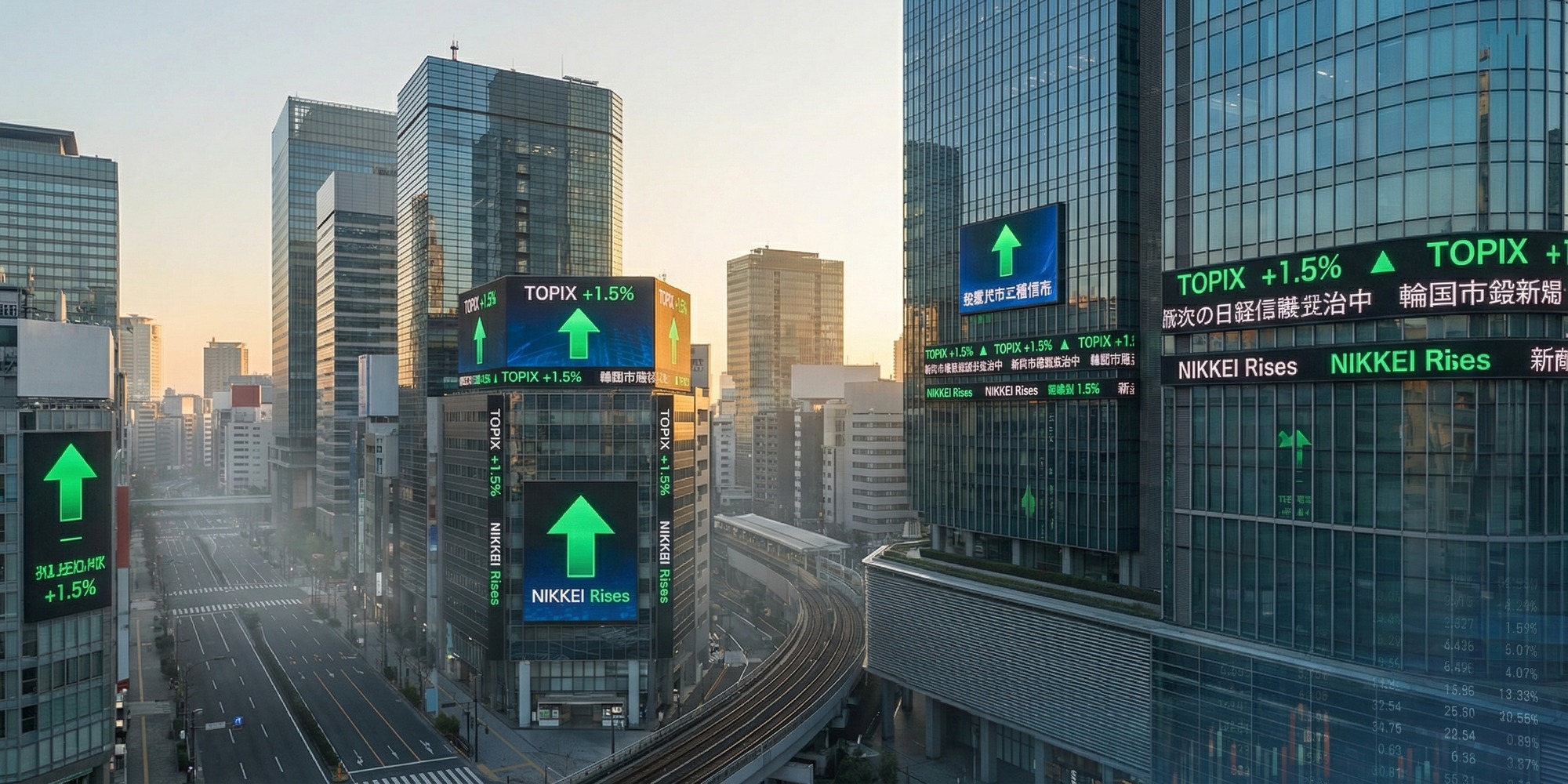
Asian equity markets posted their strongest coordinated advance in weeks on Wednesday, as early-session reports of a 15-point Iran ceasefire framework circulating through Pakistan's diplomatic back-channel swept across trading floors from Tokyo to Mumbai. The Nikkei 225 surged 2.87% to 53,749.62, its biggest single-session gain since February, while India's S&P BSE SENSEX climbed 2.11% to 75,632.47 and Australia's ASX All Ordinaries rose 2.03% to 8,745.30. Chinese markets also joined the advance, with the Shanghai Composite gaining 1.16% to 3,926.46 and the Hang Seng adding 0.35% to 25,150.69.
The move is a sharp reversal from the prior week's trend, in which Asian markets had recorded their third consecutive weekly loss amid escalating Iran war risk and Hormuz supply disruption. The catalyst Wednesday was not a confirmed ceasefire but the emergence of a structured diplomatic proposal — a development that markets treated as a measurable reduction in tail risk, even absent formal verification from Washington or Jerusalem.
Asia Leads — Japan and India at the Vanguard
Japan's outperformance reflects the country's acute exposure to Middle East energy flows: Japan imports approximately 90% of its crude oil, with a significant share transiting the Strait of Hormuz. Any credible de-escalation signal carries disproportionate weight for Japanese equities, particularly in the energy-intensive manufacturing, chemicals, and shipping sectors that have borne the steepest cost increases since the conflict began in early March.
India's 2.11% SENSEX advance tracked a similar logic. India ranks among the world's largest oil importers, and the Indian rupee — which had softened against the dollar through the Hormuz disruption — showed early stabilization Wednesday as oil-import risk pricing eased marginally. Australia's resource-heavy ASX benefited from both the copper rally (+1.13% to $1,132 per metric ton) and improving risk appetite for Asia-Pacific equities broadly.
China's response was more measured. The Shanghai Composite's 1.16% gain aligns with the country's structurally complex position: Beijing has maintained indirect economic ties with Tehran, and the latest round of US secondary sanctions targeting Chinese buyers of Iranian crude oil — announced by OFAC on March 24 as detailed by US Foreign Policy — introduced a new layer of bilateral trade tension that tempered Beijing's upside enthusiasm even as broader risk appetite improved.
Europe Cautious, Wall Street Skeptical
The ceasefire signal produced a more restrained response in Western markets. European indices opened modestly higher: the FTSE 100 gained 0.72% to 9,965.16, the CAC 40 added 0.23% to 7,743.92, and the STOXX 600 advanced 0.43% to 579.28. Germany's DAX was flat at 22,636.91, weighed by the country's outsized exposure to energy-intensive industrial production and lingering concerns about European gas storage ahead of the northern hemisphere's next heating season.
US equity futures presented the starkest contrast. S&P 500 futures declined 0.37% to 6,556.37, while Nasdaq futures fell 0.84% to 21,761.89. The divergence reflects a compounding of factors unique to the US market: fresh durable goods orders data released Wednesday morning missed consensus estimates, adding fuel to the stagflation narrative that has dominated Fed communication since early March. As US Market Updates reported, the durable goods miss arrived alongside oil's rebound above $100 — a combination that markets are pricing as a constraint on any near-term Federal Reserve pivot toward easing.
Oil Above $100 — The Paradox Explained
Brent Crude's 3.78% advance to $100.54 on a day of ceasefire hope requires explanation. The intuitive expectation — that diplomatic progress would ease Hormuz supply anxiety and soften crude — did not materialize. Analysts point to several intersecting factors.
First, the ceasefire framework remains unverified and preliminary. No US administration confirmation, no Israeli response, and no formal Hormuz reopening timeline have been established. The Pakistan-brokered track is a back-channel, not a signed agreement. Markets are discounting, not celebrating.
Second, and perhaps more durably significant, OFAC's secondary sanctions on Chinese Iranian oil buyers effectively reduce the de facto global supply of Iranian crude regardless of Hormuz's physical status. Iranian exports that had been partially re-entering global markets via Chinese intermediaries face new interdiction risk, tightening the net supply picture.
The OFAC move is structurally different from previous Iran sanctions rounds. By targeting the buyer rather than the seller, it forces Chinese refiners to choose between Iranian crude and US market access — a choice most will resolve in favour of US compliance.
— Analysis based on OFAC designation review, March 24, 2026
Third, broader commodity markets confirmed the risk-on-with-supply-tension dynamic. Copper's 1.13% advance to $1,132 per metric ton signals genuine demand optimism — a ceasefire scenario that restores Chinese manufacturing activity and normalises global trade flows would be unambiguously bullish for industrial metals.
Sovereign Bonds: Yields Fall Across the Board
Global sovereign yields declined in parallel with the equity rally, an unusual combination that points to real ambiguity in the current macro regime. The US 10-year fell 4.8 basis points to 4.344%. German 10-year Bunds eased 1.6bps to 2.998%, UK gilts declined 1.1bps to 4.942%, and Japanese government bonds fell 1.5bps to 2.256%.
The simultaneous decline in both equity risk premiums and government yields reflects a specific market interpretation: that a partial ceasefire de-escalation reduces the probability of a further oil-driven inflation shock, which in turn reduces the probability of additional rate hikes from the Fed, ECB, or BOJ. Markets are not pricing a full risk-on recovery — they are pricing a removal of the worst tail scenario.
What to Watch
The durability of Wednesday's Asian rally depends on three near-term data points. First, any formal response to the Iran 15-point ceasefire framework from the US State Department or Israeli government will carry immediate market impact — confirmation amplifies gains, rejection reverses them. Second, the next US PCE inflation reading, expected later this week, will test whether energy-driven price pressure has meaningfully entered the core inflation pipeline; a hot print would sharpen the stagflation trade and pressure US equities regardless of geopolitical news. Third, scheduled BOJ communications on Japan's rate path remain in focus given the yen's recent volatility — a Nikkei rally of this magnitude, if sustained, may encourage the BOJ to signal a more measured approach to further tightening.
Europe's calendar includes Eurozone flash PMI data and a scheduled ECB speaker panel. For the ECB, the calculation mirrors the Fed's: a ceasefire scenario that reduces energy input costs loosens the constraint on rate cuts, while OFAC sanctions that maintain oil supply tightness keep the inflation watch active. The FTSE 100's outperformance within Europe — +0.72% versus the DAX's flat close — reflects the UK's relatively lower direct energy-import dependency and the FTSE's heavy weighting in commodity and financial stocks that benefit from higher oil prices.